


3 Things That Standout at Interlachen Country Club - Edina, Minnesota
By Mason Savage

If you are a golfer, it is almost certain that you have a bucket list of courses that you want to play some day. Places like Pinehurst No. 2, The Old Course at St Andrews and Pebble Beach are great to have on the list because while they are cathedrals of the game, they are Public courses that you could play someday without any help. However, there are private clubs that are on bucket lists and the average golfer can only dream to make a connection some day to play it. Places like Augusta National, Pine Valley or Royal Mebourne are fun to dream about but deep down, how realistic is it to actually play these world renowned private courses?
For most of my life, Interlachen Country Club (Edina, MN) fell into that second bucket of courses. A private course that would be amazing to play but I never got my hopes up as it is an exclusive and top tier course not just in Minnesota, but the United States. So imagine my surprise when an Instagram DM lead to an opportunity to knockout a big bucket-list course.
Interlachen originally open in 1910 and was a William Watson design but underwent a substantial redesign in 1921 when famous Golf Course architect Donald Ross changed the course to more fully utilize the natural flowing terrain on the ground. There have been many projects and little chunks of work conducted over the next century until Andrew Green did a complete restoration of the course in 2024. He touched every green, every bunker and did some minor rework to capture the original design and intent that Donald Ross had over a hundreds prior.
Going into the round, I had expectations of what the course would be like. I expected it to be difficult as Interlachen has hosted numerous USGA Championships including Bobby Jone's historic win at the 1930 US Open. At the same time, coming off of a restoration, I also expected some playability and large flashy slopes. What I found was a beautiful combination of the two but not in ways that I expected. While the course was difficult, it is also playable for the everyday member and those big bold slopes I expected from a restoration, no where to be found. Instead, I found a subtle and stern property that exceeded expectations.
It has been about 6 months since I played Interlachen and I think about the course all of the time. However, for the sake of brevity, I want to highlight 3 things that I still think about at Interlachen Country Club. These are not necessarily the best or most important parts about the golf course, rather these are the ideas and thoughts about the course that stick out to me that I feel not a lot of people talk about.
The Routing
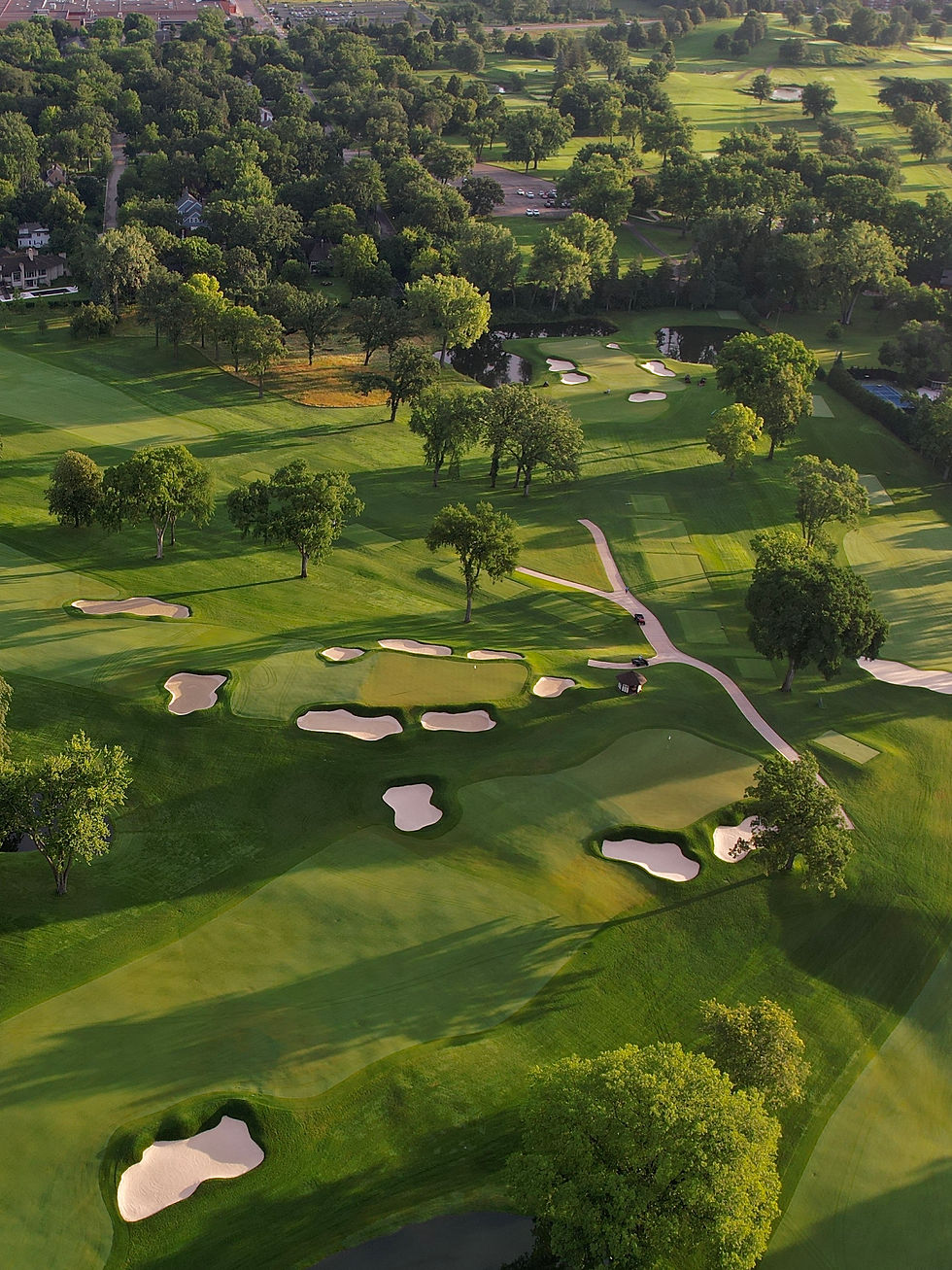
I think a good golf course Routing is like good Offensive Line play in the NFL. Only real sickos in the respective sports can appreciate it and know what it looks like. The Routing at Interlachen is truly a masterpiece in how to route a golf course. The course flows naturally and yet allows you to get lost on the property. One thing the course does really well is how intimately the front 9 at Interlachen is woven together. Some examples of this front 9 routing are the 2nd hole nestled between 8 and 9, the 7th hole being slotted between the 4th and 9th hole and the fact that no two holes go in the same direction which allows for diverse play patterns in different wind directions. The back 9 is also no slouch in the routing department either. Holes 11 through 17 are across Interlachen Blvd and allows for its own intimate routing on a smaller paddock of land.

However, maybe the one thing that the routing does the best is it utilizes the best land for golf and makes use of natural green site locations. This is made abundantly clear when you look at a map of the course and see that green sites tend to congregate at certain portions of the property. This is more prevalent in Golden Age Architecture where the ability to move earth was limited and therefore architects had to make the most of the natural land given. However, many great golf course architects make use of this technique today such as Coore and Crenshaw and Tom Doak. The land that Interlachen sits on has lots of movement and is the perfect human scale for a golf course. It is the perfect culmination of great golf architecture on a great piece of land.
Subtleness
I mentioned this earlier in the article but I think it is worth highlighting again, Interlachen is a very subtle golf course. I can only imagine how sweet it is to be a member and play it repeatedly year after year. The replay-ability of a golf course is maybe one of the biggest glowing endorsements one could have about a piece of property. Now this isn't to say there are not "obvious" things at Interlachen. Water Hazards are still visible and obviously "bad" to be in. Likewise, Bunkers are still visible and obviously "bad" to be in. The thing that I am talking about more is the contouring around the green complexes.

The slopes and areas of danger are not glaring when you are coming into a green so if you do not have great course knowledge or an even better caddy, you could inadvertently leave yourself an impossible chip or maybe even an impossible two putt. One specific instance I want to call out is the 10th hole. I had a putt that obviously broke right to left and I read it about a ball and half outside of the hole. After asking my caddy to confirm the read, I was informed that actually the break was closer to 3 feet and if I was not careful, I would be 3 putting. Sure enough my caddy was right. This was one of the many times I severely under read break on the greens or left myself a chip where the slopes of the green were working against me. It is this subtle brilliance that can only fully be realized if you are able to play the course. It is for this reason that I do not think it gets talked about as much as it should.

The 12th Hole
The 12th Hole truly might be one of my favorite golf holes I have ever played. The 12th Hole is a massive, true 3 shot Par 5 that heads east and plays away from a typical Minnesota prevailing wind. Off of the tee there are two strategically placed bunkers on the left because if you want a chance to maybe reach the green, you will need to favor the left side of the fairway to make the hole shorter. Also protecting the left side of the hole are Andrew Greens signature "chocolate drops" which are little mounds that create uneven lies and potential bounces to punish players.

When coming into the green whether it is your 2nd or 3rd shot, the main worry is to not be short. Protecting the front of this green are a series of extremely deep bunkers and an elevation change that can create blind wedge shots if you are too close to the green complex. Me personally when I played, I would argue I laid up almost too close to the green as I was barely able to see the flag on my third shot. It is not the end of the world but have a blind shot into a green is always a cheap and easy way for a golf course architect to create some anxiety in the player hitting the shots.

Once you are on the green you at one of the higher points on property and rewarded with a beautiful panoramic view of the entire south portion of the golf course. As is to be expected at Interlachen, the green complex is wonderful with all sorts of subtle interior contours.

Fun fact: Before Interlachen was a golf course, it was Farmland and the farm house in which the course was purchased in was located around the 12th green. A fitting place for a home if you ask me.

Comments